Bel ons
+32 56 77 36 04
00 items


Price range: €28.06 through €88.72 incl. VAT

For parquet and furniture coatings as well as the surface treatment of wood in the interior, such as living room and bedroom, children’s furniture, wall and ceiling paneling. The chemical and mechanical resistance depends on the number of applied oil layers. Also for stairs and handrails.
| Giscode | KH1 |
| Flow time | 57 s / DIN EN ISO 2431 – 4 mm |
| Appearance | Colorless |
| Decopaint base | LB |
| Decopaint category | J |
| Density series kg / l | 0897 |
| property profile | Lichtschutzmittelhaltig |
| Packaging | liquid |
| NfA | 56% |
| NfA series% | 50.7 |
| VOC FR | A + |
| Number of layers (max) | 2 |
| Quantity per shift (max) | 30 gsm |
| Quantity per shift (min) | 10 gsm |
| Total contract amount | 60 gsm |
| desiccation | 8 h / 20 ° C |
| Overpaintable within | 24 h / 20 ° C |
| curing | 7d / 20 ° C |
| Walkable to | 24 h / 20 ° C |
| Resilient after | 7d / 20 ° C |
| Surface preparation | In the furniture sector: Clean, dry wood, depending on the type of wood, application process and desired effect. In the parquet area: Careful, even and graded raw wood sanding of the correctly laid and prepared parquet surface. |
| Ground grit grit from-to | 120 – 320 |
| Final treatment | After sufficient drying. In the furniture sector: Regular cleaning and care with Proterra Cleaner GR 1900. In the parquet area: Initial care and subsequent maintenance with Hesse PROTECT-CLEANER PR 90 or Hesse ANTISLIP-CLEANER PR 93 and Hesse INTENSIV-CLEANER PR 91. |
| Comments | The raw wood cut must be matched to the desired order quantity. The smaller the application quantity, the finer the cut (up to grain 240 when padding). Pay attention to the uniformity of edge and surface grinding.The quality of the cut is crucial for the end face! |
| Working temperature | 20 ° C |
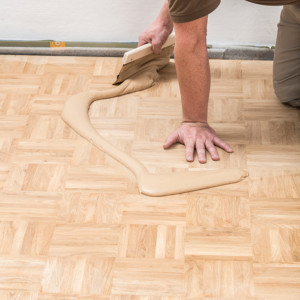
| processing instructions | Hand spatulas: thinly trowel or roll up, then immediately padding / grinding in. Larger areas should be worked by 2 people. Hand application: Grind in with abrasive fleece and remove surplus with cotton cloths without residue. In the furniture sector: Apply the material with a saturated, fine sanding fleece and sand. After a short period of action, remove the excess with cotton cloth. The surface should appear dry, otherwise dry-drying problems can be expected. In the parquet area: Apply the material with a suitable spatula. After a short exposure time, work in a uniform manner with the single-disc machine and the white, non-abrasive pad until the surface appears dry. |
| special instructions | Material is not suitable for bluish wood in wet rooms. The material properties were tested on commercially available woods such as oak, beech, etc. When using on other woods please check suitability beforehand.To avoid white pores on dark, porous woods, we recommend using the glossy version of the oil, at least for the first layer. A 10: 1 hardening with OR 87 or 100: 4 with OR 88 increases the mechanical and chemical resistance of the surface. The addition of hardener accelerates through-drying. Working time of the mixture for 1 h at 20 ° C room temperature. The chemical and mechanical resistance depends on the number of applied oil layers. The material dries oxidatively, please observe general instructions for processing. The parquet must not be covered with foils or carpets before reaching the final hardness. Due to the high reactivity, skin formation can occur. Please remove before stirring. Subsequently, the material should be sieved as a precaution. Stir thoroughly before use. Please observe the latest safety data sheet! |
| General instructions for processing | Oxidative drying materials: In the containers, mainly in break-away containers, a skin may form on the surface of the oil. It must be removed before use. Low temperatures, increased humidity conditions, insufficient air exchange and drying retardant wood ingredients can prolong the drying time of the oil. Coating materials which develop during the drying heat (oxidative drying oils) and coating materials are the highly flammable deposits, must not because of the danger of spontaneous combustion readily be processed the same spray booth (see BGR 500 Chapter 3: processing of various coating materials). Cotton cloths, cardboard, paper soaked in oil are in danger of self-ignition due to heat build-up, so they can be dried in the air and then disposed of. Even wood dusts soaked in oil tend to self-ignite, please do not dispose in closed containers; as far as possible, do not grind in the spray booth. The oil itself is not self-igniting. The required cleaning, care and refreshment intervals are to be matched to the number of applied oil layers, as well as the type and intensity of the stress. The material properties were tested on commercially available woods such as oak, beech etc. For soft, colored, exotic or unknown wood species, resins can lead to drying delays and visual impairment. Therefore, please check the suitability for use on these woods beforehand. Please note that oils, like almost all natural materials, change their color in the course of time under the influence of light and / or heat. They change their color both under the influence of light (eg UV rays of the sun, etc.) and under light (dark yellowing, for example, under tablecloths, carpets, cupboards, etc.). This can be especially noticeable in brightly pigmented surfaces. Oiled surfaces have a typical smell.This decreases with increasing drying over the course of days. Instructions for cleaning and care: Please observe the care instructions according to DIN 18356. Parquet with soft cloths only damp, not wet wipe.Please use only neutral, silicone, sal ammoniac and abrasive cleaners. Regular care and cleaning with Hesse PROTECT-CLEANER PR 90 and Hesse INTENSIVE-CLEANER PR 91 increase the life of the sealant. do not wipe wet. Please use only neutral, silicone, sal ammoniac and abrasive cleaners. Regular care and cleaning with Hesse PROTECT-CLEANER PR 90 and Hesse INTENSIVE-CLEANER PR 91 increase the life of the sealant. do not wipe wet. Please use only neutral, silicone, sal ammoniac and abrasive cleaners. Regular care and cleaning with Hesse PROTECT-CLEANER PR 90 and Hesse INTENSIVE-CLEANER PR 91 increase the life of the sealant. |